Meet the Illustrator: Clara Dackenberg on the creative process behind The Playdate, shortlisted by the Carnegies 2026


In the second post of our ‘Meet the Creator’ blog series, we are joined by Clara Dackenberg, illustrator of The Playdate. We are so proud to say that The Playdate has been shortlisted for the prestigious Carnegie Medal for Illustration 2026—massive congratulations! The Playdate, written by Uje Brandelius and translated by Nichola Smalley, is a powerful story about the friendship between two children from very different socioeconomic backgrounds. The illustrations do not simply follow the text but run parallel to it, visually unraveling the story in a surprising and quietly poignant way. In this interview, Clara gives us a glimpse into her creative process behind the scenes—creating characters, a favourite moment, her workspace essentials, and a message to young readers.
What was your process for creating the characters in The Playdate? How did you make them feel authentic and relatable to children?
Clara: I didn’t need to struggle, as is sometimes the case, to find the characters in The Playdate. I emailed my initial sketches to the writer Uje Brandelius and our publisher Erik Titusson, and they both thought they were spot on. I did sweat a little bit over Henry’s mum though. In my first drawings she was wearing a chic down vest, which perhaps could have been perceived as an upper middle class stereotype. In the end she got to wear a pink wrap-around cardigan that felt a bit more neutral.
Even if the theme of the book may feel quite heavy I think the many illustrations where we find the children playing can provide a lightness and relatability to the young readers.
Pick one of your favorite spreads from The Playdate and walk us through how it came together. What did your early sketches look like? How did you shape the storytelling on the page, and what changed along the way?

Clara: My favorite spread from the book might be the one where the main character finds a robot in a storage room at Henry’s house. A robot just like the one she dreams about having more than anything in the world. The robot is too expensive for the girl's mum, but here it is, hidden away in a bag full of toys that Henry probably has grown tired of. What I like about this scene is probably the uncertainty – will she or will she not be able to resist taking the robot with her …
If I were to redo the illustration today, I probably would have done it differently, with more colour, contrast and drama, but I do like the quietness and paleness in this image. I think it captures the stillness of time in a space like this – a storage room with products once attractive to buy, now waiting to be thrown away. Maybe the scene also reflects on how time is suspended momentarily while she considers doing something forbidden.
What was your favorite moment while working on The Playdate?
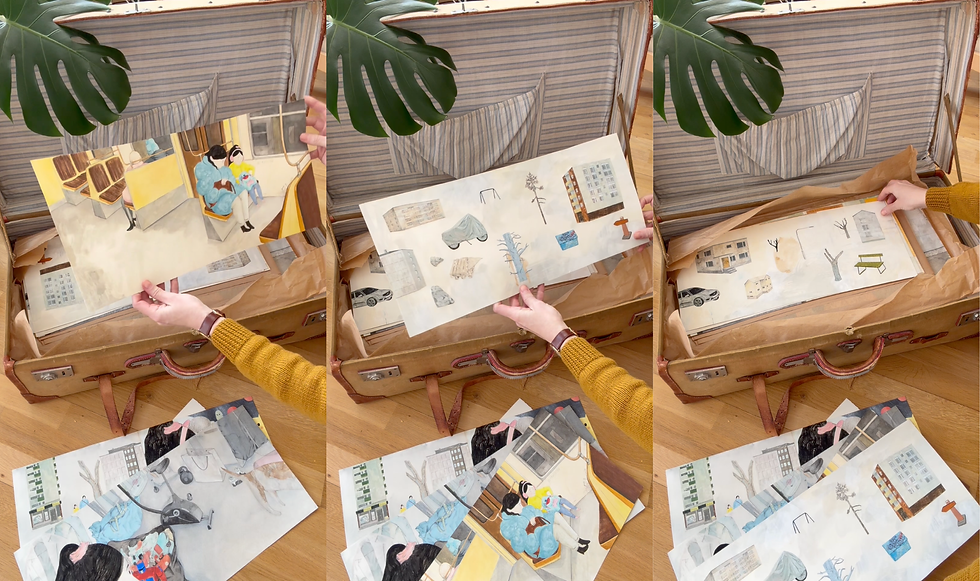
Clara: Working on The Playdate was a delight from beginning to end. The story is told in a way where the images aren’t just supposed to follow along with the text, but instead entrusted to deliver their own narrative. Thanks to this, the work process was a perfect mix of freedom and responsibility. But if I am to pick one favorite moment, it would be when all the illustrations were finally made and I got to design the endpapers. I love using the endpapers as a wrapping for the main story, with their own quiet, subtle narrative. In The Playdate, the endpapers in the beginning of the book show a collage of exterior elements from the residential area of the girl and her mum, and the ones in the back show motives from Henry's neighborhood.
Where do you work? What are the essentials in your workspace?
Clara: I work from my home in southern Sweden, in a combined living room and workspace, where I have good natural light coming in through big windows facing east. Daylight is an important factor for me, since I have a hard time working in artificial light, especially when using colours! And yes, I do curse a lot at the long, dark Swedish winters.

What mediums and styles do you enjoy working with the most?
Clara: I do all my illustration work using analogue techniques – collage, watercolour, gouache, pastel and pencil on paper. I’m sure it would be a lot more practical to illustrate digitally, but I would never want to swap the multisensory experience of painting on paper for work on a screen. I do love my unpractical, unpredictable and time consuming illustration process after all.

What do you hope children feel and learn when they see your illustrations in The Playdate?
Clara: I believe the book can be read and understood at many different levels and I hope that children reading The Playdate get a chance to reflect, to a degree that suits them, on unequal living conditions and how friendship has the potential to bridge socioeconomic gaps. I hope the readers feel strongly for the main characters – the little girl and her friend Henry – but I also hope the book raises questions about the circumstances surrounding their friendship.
Later this month, we will feature another one of our illustrators whose work has also recently been shortlisted by The Carnegies 2026—Oboh Moses, illustrator of Freedom Braids. Keep an eye out for this space!